How Much Is Parking At The California Science Center?
Exposition Park parking explained: what the lots charge, why the Expo Line beats driving, and how to plan a science museum day without guessing at figures.
How Much Is Parking At The California Science Center?
Parking at the California Science Center is paid, but there is no single rate this site can honestly quote. The lots around 700 Exposition Park Drive are managed by Exposition Park and nearby institutions, prices shift with events at the Coliseum and BMO Stadium next door, and the museum's own site is the only reliable source for the current day's price. Since general admission is free, parking is usually your biggest cost.
That last sentence is the whole story of museums in this city, and it is why a parking guide for a free museum is not a strange thing to write. In Los Angeles the ticket is often free and the car is not. At the Getty Center, for comparison, admission and the timed reservation both cost nothing while parking runs $25 per car, dropping to $15 after 3pm, a figure verified directly on the museum's own parking page. Exposition Park works differently: the Science Center does not own a garage with a published flat rate the way the Getty does. It sits inside a shared public park alongside the Natural History Museum, the California African American Museum, the Coliseum and BMO Stadium, and the parking around it is event-driven.
This has a practical consequence worth planning around. On a quiet weekday, the lots are cheap and half empty, and you will park within a short walk of the door. On a game day at the Coliseum, the same lots fill hours before kickoff, prices climb, and some entrances close entirely. If your visit is flexible, check the Coliseum and BMO Stadium event calendars before you pick a date. A Tuesday morning with nothing scheduled at either stadium is the closest thing Exposition Park has to a guaranteed easy arrival.
The honest summary, and the one this site will stand behind: expect to pay for parking, check the Science Center's own site for the current rate on the day you go, and treat any flat number you read elsewhere with suspicion. Anyone quoting an exact figure without pointing at the park's own pages is guessing, and the guess is usually stale.
If you are building a wider science-and-nature day in the park, these are the three products worth a look before you leave home:
Where To Park In Exposition Park
The main lots sit along Exposition Boulevard and Bill Robertson Lane, west and south of the museum buildings, and all of them are paid. The California Science Center's own visitor page lists the current rates and the lots it recommends, and that page is the one to check the morning of your visit. There is no free on-street parking in the immediate park, and the residential streets south of Exposition Boulevard are permit zones.
The geography matters more here than at most LA museums, because Exposition Park is compact and walkable once you are inside it. The Natural History Museum at 900 Exposition Boulevard, the California African American Museum at 600 State Drive and the Science Center at 700 Exposition Park Drive are all within a few minutes' walk of one another, so one parking spot genuinely covers three museums. That is unusual in this city. The Miracle Mile museums on Wilshire Boulevard, by contrast, each have their own garage, and hopping between LACMA, the Petersen and the Academy Museum means either paying twice or walking a long block with the La Brea Tar Pits in between.
| Arrival option | What to expect | Cost certainty |
|---|---|---|
| Exposition Park lots | Closest to the museums, fills on stadium event days | Paid, variable, check the Science Center's site |
| USC campus garages | North of the park, walkable, event pricing on game days | Paid, check USC's parking pages |
| Metro Expo Line, Expo Park/USC station | Steps from the park entrance on Exposition Boulevard | Flat Metro fare, no parking at all |
| Ride-hail drop-off | Drops at the museum entrance on Exposition Park Drive | Meter by trip, no parking risk |
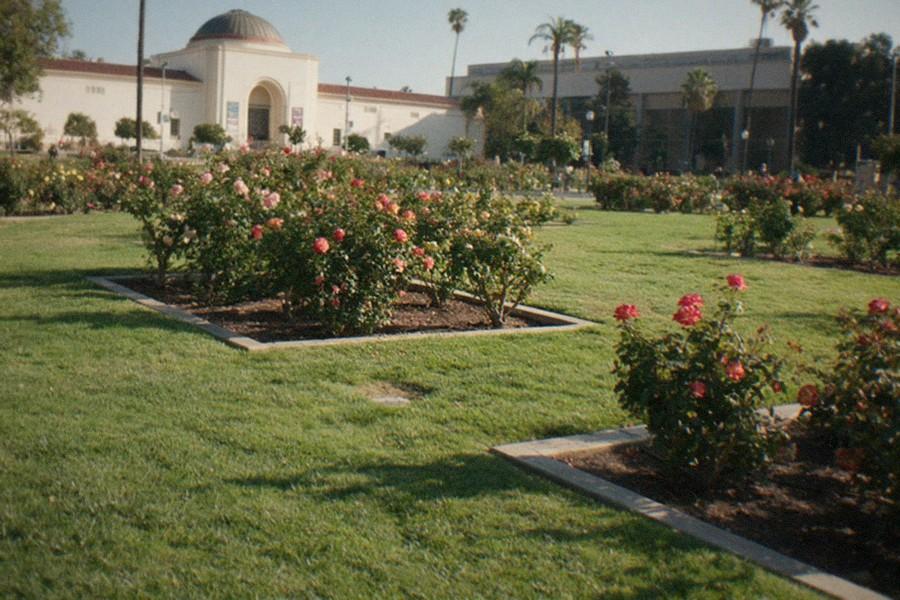
One more thing to plan for: the park's lots are also where the Rose Garden crowd parks, and the garden between the Natural History Museum and the Coliseum is free and worth the walk on its own. In spring the lot nearest it fills early on weekends for reasons that have nothing to do with either stadium. Arriving before late morning sidesteps most of it.
A word on the ride-hail row in that table, because it is the option people forget. On a stadium event day, a driver dropping at the Science Center is fighting the same street closures and lot queues as everyone parking, and surge pricing follows the crowd. On a quiet weekday it is the simplest arrival there is, a clean drop at the door on Exposition Park Drive with no circling at all. The deciding factor is always the same one: is there an event at the Coliseum or BMO Stadium today or not.
Getting There On The Expo Line
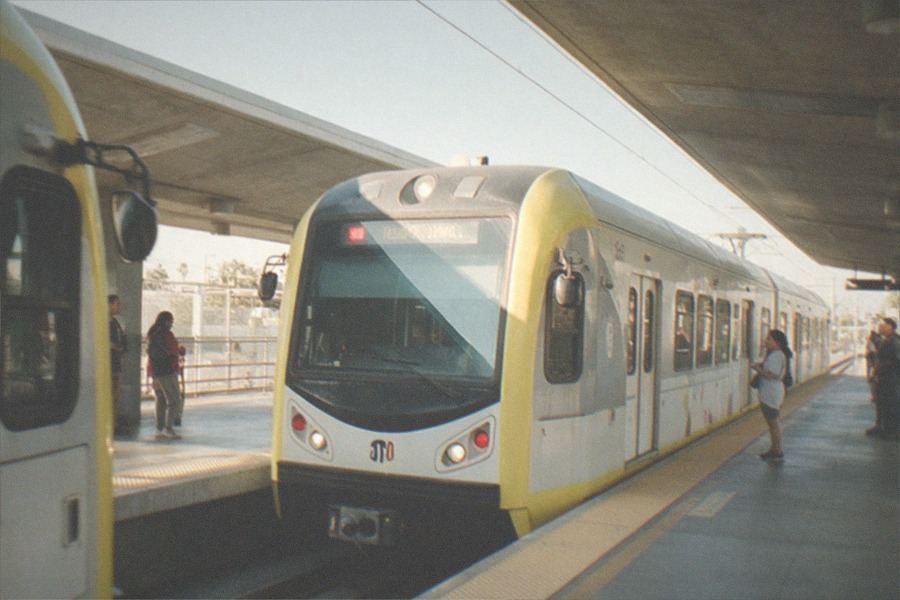
The Metro E Line, still called the Expo Line by nearly everyone, stops at Expo Park/USC station directly on Exposition Boulevard, a couple of minutes' walk from the Science Center's entrance. It is the one arrival method in this article with a flat, published, non-event-dependent cost, and it removes parking from the day entirely. From downtown Los Angeles the ride is about ten minutes.
This is the genuinely easy option, and it deserves the emphasis. Los Angeles is a city where the museum is often free, the parking is paid, and the transit alternative is a myth. Exposition Park is the exception. The station is not a block away or across a hostile intersection: it sits on the park's northern edge, and the walk from platform to museum door passes the Rose Garden rather than a freeway ramp. For a family with two adults and three children, the arithmetic is blunt. Parking at a variable event-driven rate for a few hours, against two flat tap-in fares for the adults and reduced fares for the kids, and no circling for a space.
The same line also connects the park to downtown's museum cluster in one ride, which opens a two-stop itinerary. Grand Park and the Civic Center stations put you within walking distance of The Broad on South Grand Avenue, MOCA Grand Avenue a block further, and the GRAMMY Museum down at LA Live. The Broad is free too, with timed tickets released monthly that go fast, so a free-museum day paired with a rail pass is a real thing this city quietly supports. Our downtown Los Angeles museums guide lays out that cluster in full.
And if the Science Center is your destination rather than a stop, it is worth knowing what you are walking toward. The permanent galleries are free, the IMAX theater and special exhibitions are ticketed, and Space Shuttle Endeavour is off display until the Samuel Oschin Air and Space Center opens on 13 November 2026. Anyone promising a shuttle viewing before that date is working from an old article.
What Your Ticket Gets You, And What It Does Not
General admission to the California Science Center is free, and that has not changed. What costs money inside is the layer on top: IMAX films, special exhibitions, and group bookings of twenty or more are all ticketed separately. Parking, if you drive, is the other paid layer, and for most visitors it is the bigger one. The museum is open daily, one of only a handful in the city with no closed weekday.
The free tier is genuinely substantial. The permanent galleries cover ecosystems, space hardware and the science of everyday objects, and a family can spend a full afternoon in them without buying anything beyond parking or a Metro fare. The paid tier is where the museum makes its money, and the IMAX adult price in particular stayed unresolved across this site's research passes, so it will not be quoted here: check the listing or the museum's own site. What the site can say is the shape of the decision. If you are going for one IMAX film and one special exhibition, the paid add-ons will exceed the parking cost. If you are going for the free galleries, parking or transit is the whole budget. The wider set of guides lives on Los Angeles Museums.
This free-core, paid-shell structure is worth understanding because it repeats across Los Angeles and catches out visitors who read only the first half of a sentence. Griffith Observatory's building is free while its planetarium shows are ticketed. The Broad's general admission is free while its special exhibitions can be ticketed separately. The Getty's galleries are free while the car costs $25, or $15 after 3pm, confirmed on the museum's own parking and transportation page. The pattern is consistent enough that the honest question is never "is it free?" but "what part of it is free, and what will I actually pay for?" Our free museums in Los Angeles guide works through which of the city's thirty museums fit the pattern and what the catch is beside each one.
For a full day in Exposition Park, the natural pairing is next door. The Natural History Museum is a paid museum, $18 at the door, with dinosaurs, dioramas and the gem halls, and it carries a 4.6 rating across 522 reviews on its listing. LA County residents get free admission on weekday afternoons, on site only. Park once, or tap in once, and the two museums make a single coherent day.
How Expo Park Parking Compares Across The City
Exposition Park is mid-pack on parking pain. It is cheaper and easier than the Getty's flat $25 on most days, roughly comparable to the Miracle Mile cluster, and far less predictable than either because of the stadiums. The museums where parking is genuinely cheap are the Westwood pair: the Hammer Museum charges roughly $8 to $9 for the first hours with validation and a daily max around $22 to $30.
The Fowler Museum at UCLA sits in campus parking quoted at about $5 an hour to a $17 daily maximum. Those figures are single-pass approximations and should be treated as ranges, not promises. The comparison matters because Angeleno parking is not uniform, and visitors who budget from one museum's garage price get surprised at the next. The verified, stateable numbers are few in this city, and this site treats them as a scarce resource. Getty Center and Getty Villa parking is $25 per car, $15 after 3pm, with the Villa adding a $10 after-6pm rate for evening events: those are confirmed. The Petersen Automotive Museum's listing states its price excludes a $17 parking fee, so a $22 door ticket is really $39 for a driver. Everywhere else, the instruction is the same one given above for Exposition Park: parking is paid, and the museum's own site has the current number.
| Museum | Area | Parking reality |
|---|---|---|
| California Science Center | Exposition Park | Paid lots, event-variable, check the museum site |
| Natural History Museum | Exposition Park | Same park, same lots, one spot covers both |
| The Getty Center | Brentwood | $25 per car, $15 after 3pm, verified |
| Petersen Automotive Museum | Miracle Mile | Listing notes a $17 parking fee excluded from the ticket |
| Hammer Museum | Westwood | Roughly $8 to $9 with validation, daily max around $22 to $30 |
| Griffith Observatory | Griffith Park | Paid near the building, free further downhill |
One cluster deserves a special warning. The Miracle Mile museums, LACMA, the Petersen, the Academy Museum and the La Brea Tar Pits, share a stretch of Wilshire Boulevard where every garage is paid and street parking is a lottery. The Tar Pits' museum building is closed for renovation, but Hancock Park, the Lake Pit and the outdoor excavator tour are open and free to walk, so drivers still roll into those lots expecting a museum and find a construction site with a view of bubbling asphalt. The park itself is the attraction for now, and it is worth the stop, just not worth an indoor-museum expectation.
A few practical conclusions follow from the numbers above. If your day is flexible, arriving at the Getty Center after 3pm cuts the parking from $25 to $15, a $10 saving per car that stacks with whatever the visit itself costs. At the Petersen, remember the $17 fee when you compare ticket prices across the Miracle Mile, since the $22 listed door price is really $39 for anyone driving. At Exposition Park, the California Science Center and the Natural History Museum share the same lots, so one paid spot covers both buildings, which is the one clear bargain in this comparison. And at Griffith Observatory, the free option exists, just not at the curb nearest the building, so the walk downhill is the price of the free space.
Budget accordingly if you are planning several museums in one trip. A driver doing the Getty Center, the Petersen and the Hammer in a single day faces parking in the $40 to $50 range before any admission, while a visitor who walks, rides shares or takes transit to the same three buildings pays nothing for parking at all. That gap is the single biggest controllable cost in a Los Angeles museum itinerary, and it is the reason this section keeps repeating the same instruction: check the museum's own site for the current number before you leave.
Planning The Day: Closed Days, Neighbors And Timing
The California Science Center is open daily, which is rarer than it sounds: most LA museums close at least one weekday, and several close two or three. That makes it the anchor of any flexible itinerary, because it is the one building in the park that never tells you to come back tomorrow. The Natural History Museum closes the first Tuesday of the month, and the California African American Museum closes Mondays.
The Wende Museum in Culver City, for anyone building a wider route, opens only Friday to Sunday, 10am to 5pm. Plan around the Science Center, not around its neighbors, and let the closed days of the others dictate which day of the week the whole outing lands on.
Timing inside the day matters almost as much as the date. School groups move through the Science Center in weekday morning waves, and the galleries are calmest in the first hour after opening and again after about 2pm. The parking lots mirror that rhythm on non-event days, filling toward midday and thinning after lunch. Combine the two and the sweet spot is obvious: arrive at opening, do the free galleries while the groups do their worksheets, and let the afternoon carry you next door to the Natural History Museum or out to the Rose Garden. If you are coming on the Expo Line, the same logic applies without the parking anxiety, and off-peak fares and seats are both easier after the morning rush.
The rail-and-free-museum combination also scales down toward Long Beach if you have a second day. The Aquarium of the Pacific at Rainbow Harbor is the science-and-nature day trip in this cluster, $49.95 at the door, 4.5 across 794 reviews on its listing, open daily, and children under 3 are free on the ticket. It is not strictly a museum, and this site says so plainly, but it scratches the same itch as the Science Center's aquarium-adjacent galleries, with actual ocean outside the window. Our science museums in Los Angeles guide ranks the full set.
For now, the practical close on the parking question itself: budget for paid parking, verify the rate on the museum's own page the day you go, and if the Coliseum or BMO Stadium has an event, take the Expo Line instead. That is the entire strategy, and it fits on a sticky note.
Common Questions About California Science Center Parking
How Much Is Parking At The California Science Center?
Exposition Park parking is paid and the rate varies, especially on stadium event days. There is no single verified flat figure; check the California Science Center's own visitor page for the current rate on the day of your visit.
Is the California Science Center itself free?
Yes, general admission to the permanent galleries is free. IMAX films, special exhibitions and groups of 20 or more are ticketed separately, and parking is paid if you drive.
Can you get to the California Science Center without a car?
Yes. The Metro E Line stops at Expo Park/USC station on Exposition Boulevard, a short walk from the museum entrance. It is the one arrival option with a flat, published cost and no parking at all.
Is Space Shuttle Endeavour on display?
No. Endeavour is off display until the Samuel Oschin Air and Space Center opens on 13 November 2026. Any guide describing a current shuttle viewing is out of date.
Does one parking spot cover the other Exposition Park museums?
Yes. The Natural History Museum and the California African American Museum are a few minutes' walk from the Science Center, so a single spot covers all three. Check each museum's closed days before you plan the full circuit.
When is Exposition Park parking hardest?
On event days at the Coliseum and BMO Stadium next door. Lots fill early, prices climb and some entrances close. Check both stadiums' event calendars before choosing a date, or take the Expo Line instead.
Is the California Science Center open every day?
Yes, it is open daily, one of the few museums in Los Angeles with no closed weekday. Its Exposition Park neighbors are not: the Natural History Museum closes the first Tuesday of the month and the California African American Museum closes Mondays.